A Dance with Dragons (Song of Ice and Fire) Reading Day

So a few of us die-hard fans read the 5th in the series of Song of Ice and Fire by George R.R. Martin on July 12, 2011, the book’s publication date. (Others came and read the earlier volumes to catch up with the series.)  A memorable experience to say the least.  And it’s wonderful that after 5 years of long wait, the book proves to be QUITE good!  We read in the Library’s Reading Room, at Shake Shack, and also Barnes&Noble (where we were treated as annoying and loud plagued gnomes and we just couldn’t stay too long…)  The day started about 9:00 a.m. and ended at 8:30 p.m.

Posted in Events, Fantasy | Leave a comment

The Gunslinger

“The man in black fled across the desert, and the gunslinger followed.”


Thus begins Stephen King’s epic seven-book odyssey of the gunslinger Roland and his quest for the Dark Tower.

The Gunslinger, and The Dark Tower series that follows, deftly crosses genres; parts classic western, science fiction, fantasy, horror and Arthurian legend, The Dark Tower series travels through wastelands filled with the decrepit remains of civilization, in and out of time and dimensions, and ultimately serves as meta therapy for an author devastated by a terrible accident.

The Gunslinger begins in the middle. We are introduced to the gunslinger Roland (think classic Clint Eastwood’s The Man with No Name), the last of his kind and the remaining hope for a world that has moved on, in pursuit of the Man in Black. As the story progresses, we discover that this chase has been one that has obsessed Roland since his childhood, consuming him beyond reason. In his tracks, Roland has lost his mother, father, close friends, and lovers along with most of mankind. He is a man with a morality served in the moment, one that functions to serve his driving need to capture the Man in Black and ultimately reach the Dark Tower in his quest to save the world. We are introduced to a colorful cast of characters along the way in the form of an isolated hermit with a talking crow, a weathered bar-maid ensnared in a deadly trap, zombified “weed-eaters”, a lost boy from New York City and a host of slow mutants trapped underground.

The writing here paints a sparse picture of a wasteland. The gunslinger spends the greater part of the story traveling across a barren desert, with a few intermittent stops at isolated hovels or near vacant ghost towns. The novel is driven by the gunslinger’s internal drama and insatiable need to reach the Man in Black who is the key to ultimately reaching The Dark Tower itself. For this reason, action is relegated to the background, with a few hard-hitting encounters as well as flashbacks that establish Roland’s gunslinger training. King prefers to set up the core drama/conflict of the story and leaves the larger details for the subsequent novels. In fact, several of the series key players are not introduced until the second book. The Gunslinger is concerned entirely with the quest of Roland and firmly establishing who he is as a character.  King infuses a dialogue laced with language and slang common to readers of today, though spoken in an archaic tongue with elements of both western and fantasy. That said, there remain scenes filled with classic King horror and violence, all interlaced with a heady amount of magic and prophecy.

As a stand-alone book, The Gunslinger represents the beginning efforts of a young writer. It is clear that a great deal of thought went into each word and sentence, and that King was working hard at developing his world. As the series progresses however, the pacing quickly increases and the story drives forward. One of the great joys in reading The Dark Tower is not only traveling with Roland and his Ka-tet, but with the journey of King as he develops as a writer. King goes so far as to make himself a character in the later novels using his real life brush with death (a devastating car accident that nearly killed him crushing his pelvis and braking multiple bones) as a basis for the story and clearly as a form of therapy for his own demons. It’s a personal story that allows readers access into the author’s psyche. In addition to the author himself, King often uses characters and settings from his large collection of other novels as if every novel he has published filters through The Dark Tower.

King is typically boxed into the category as a pure horror writer. Sadly, for those who have not read the greater body of his work, this label is a misrepresentation of his style. While he prefers to reside in the supernatural, King’s great strength is in his characters who are often flawed, fighting against a supernatural force. He developed the idea for this series as a 19 year old fascinated with the Lord of the Rings and other such epic tales and inspired by the poem “Childe Roland to the Dark Tower Came”, by Robert Browning. The Gunslinger took him 12 years to finish, and The Dark Tower series as a whole has taken him over 30 years to write, with a new installment to be released in 2012. In addition to the novels, several graphic novels have emerged, and it was recently announced that a movie/television series staring Javier Bardem as Roland is in the works.

The Dark Tower showcases what I believe to be one of the best examples of a crossover series. In many years of reading sci-fi, fantasy, and horror, I’ve never encountered a series that so successfully straddles multiple genres. If you are a reader who revels in the epic journey, but tired of the over-saturated two-bit rip offs of The Lord of the Rings or the over-bloated fantasy tales that permeate the fantasy market, then this is the series for you. The Gunslinger is fresh and unique while still working within the framework of the hero’s quest; however, instead of swords and armor the reader is treated to a hero who wields two six-shooters, a deadly aim and a bit of magic of his own.

Posted in Review: Books | Leave a comment

Thor

Thor, the latest superhero attempt from Marvel, certainly exceeded all expectations. While there were concerns among Norse mythology geeks that Idris Elba’s portrayal of an African-American Heimdall was “mythologically inaccurate” (an idiotic argument anyway, as mythology by definition is inaccurate), Elba’s performance was perhaps the best of the film. A standard coming-of-age story which sets ancient gods in a modern world (a common theme lately, see: Rick Riordan), Thor does not fail to show the epic scope of its main conflict, despite being set mostly in a New Mexico desert. Director Kenneth Branagh, an experienced veteran of Shakespeare and Harry Potter, brings life to a script which has few, if any, memorable lines, and Chris Hemsworth’s performance in the title role is certainly worth remembering.

Thor begins, as many fantasy movies do, with a prologue of sorts, which sets the stage for the greater adventure. The prologue, set in 965 AD, shows Odin (Anthony Hopkins), king of the gods, defeating the Frost Giants in a great battle. As we enter the present time, there is a spectacular shot of Asgard, the gods’ home, much more grand than Mt. Olympus in The Lightning Thief. Thor, the rash, headstrong son and heir of Odin, naturally rushes headfirst into battle, his father banishes him, where he is picked up by Natalie Portman, a scientist studying what she believes to be strange weather patterns. Portman’s character is endearingly awkward, while her assistant Darcy Lewis (Kat Dennings), a Scooby Doo-esque character, always three steps behind, provides some excellent comic relief. When Thor finds himself stuck on Earth after his banishment, he naturally learns that he must become “worthy” in order to return, with his brother, the evil Loki (Tom Hiddleston) attempting to stop him at every turn.

Thor‘s adherence to the comic book makes it easy for fans, and the acting (especially the performances of Hemsworth, Hiddleston, Elba, and Hopkins) bring to life a simple yet entrancing plot and a script that can only be called dull. The effects are titanic, with flying hammers, rainbow bridges across space and time, and golden castles, and the characters pull you in and don’t let you go until the movie is over. Hemsworth pulls together the clumsy strength and endearing stupidity of the titular character with ease, and Elba pulls off the fiercely loyal Heimdall with his deep voice and stalker-ish phrases, such as “Yes. I can see her.”

A.O. Scott of the New York Times argues that Marvel didn’t bother trying to make a good movie, because all they wanted to do was hook people for The Avengers. I don’t really get this logic personally, because if they wanted to hook people for the sequel, they’d try their best to make a good movie. If I go see a movie and it’s bad, I don’t want to see the sequel. Scott’s argument that the plot was textbook has some ground, but hey, it’s a comic book. How intricate is the plot going to get? Sure, the dialogue wasn’t intricate, but when you’re presenting an adaption of a comic book to comic book fans, dialogue is not what you’re going for. Thor exceeded expectations in everything it attempted to do. It’s not subtle or intricate because it’s simply not meant to be subtle or intricate. It has everything the comic book fans want: Amazing effects, cool fight scenes, and a good villain.

Posted in Fantasy, Review: Movies | 1 Comment

Game of Thrones HBO Review

Winter is coming.

Those are the arc words and the house slogan of Stark, one of the leading nations warring ceaselessly with each other in George R. R. Martin’s epic fantasy series A Song of Ice and Fire, of which the first book is called A Game of Thrones. However, I feel like this motto, used in the series to foretell of a long and difficult time where resources will be scarce and all will be unhappy, is all-too-relevant to the premiere of the series on HBO, the first episode of which came out on April 17. Winter is coming, indeed. And for fans of the series, there are hard times ahead.

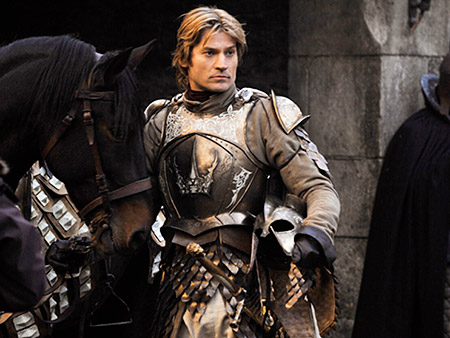
A Lannister always pays his debts. Jaime's got a lot of writers to visit...

As usual, whenever a popular series of books or other media is adapted or the TV screen, certain changes must be made. I expected this. I did not expect the writers of the HBO series to assume so categorically that its viewers would be so stupid as to mentally use the massive breasts exposed every ten minutes or so as plugs to fill the holes in the plot.
Martin’s original series was very complex, and no true antagonist or protagonist could truly be established, even by the end of the first novel. However, the HBO series makes it very clear to its viewers that the Lannisters, another warring nation who have had an old-as-time rivalry with the Starks, are the bad guys. Their personalities have been changed from angry, sad, or content to “malicious cunning,” and all subtlety has been sucked out of the interactions between humans.

That being said, the show is visually very complex. Although the sweeping landscapes and elaborate hairpieces were somewhat ruined for me because I saw the preview of the show–where we see the sets being filmed and we hear all the actors saying incredibly obvious and stupid lines of drivel (It’s so amazing…They’re just creating this whole other world!) many of the sets are beautiful and breathtaking. The title sequence is particularly inventive, with an original score that made me think, “Why didn’t I think of that?” And for all their changes, the writers don’t stray too far from Martin’s original plot–there were no scenes that I felt I had unfairly missed. However, a decent amount of similarity between the series and the novel was not enough to make up for what I felt to be a blunting of many character’s personalities, an over usage of shock tactics (or should I say shock tits?) and unnecessary graphic violence and profanity, and a simplification of many of the complex plotlines that made the book so intricate and enthralling in the first place.

They actually edited out a nude scene from the book because she was too unattractive for it. HBO! HBO took nudity OUT of their show!

Winter is here.

If you’ve never read any of the books, go ahead and see it. I’ll say truthfully that Game of Thrones isn’t much different from other HBO series: there are lots of dramatic scenes, tons of sex and nudity, and the occasional witty comment. If you’re a fan of the book, I’d recommend staying away, else you might feel a need to take the black just to escape from Sersei’s wig , Khal Drogo’s eye-and-body-liner, and just Catelyn in general. I mean…ugh.

Posted in Fantasy, Review: TV | Tagged , , , , , , , , | 1 Comment

Source Code

Moon, directed by Duncan Jones, is a science fiction film gem that has quietly gained viewership and critical admiration since its release in 2009.  Source Code, Jones’ new,  larger budget sci-fi movie, deserves the same high praise from true SciFi fans.

Although not penned by Jones, who wrote the screenplay for Moon, Source Code has a similar key element: a main character who gradually comes to realize the truth of his supposed existence and seeks the freedom to control his own destiny.

Some critics claim that Moon, with its low-budget grittiness, is superior to Source Code.  I disagree.  Source Code has a much tighter pace which helps broaden the viewership and showcases Jones’ maturation as a visual storyteller.  Since the script is clean and gripping, Jones uses special effects sparingly only to accentuate the intensity of the story elements, not to divert the audience’s attention from a weak script.  A refreshing change from many recent sci-fi films.

On top of a good director, Source Code also benefits from a solid cast.  Jake Gyllenhaal proves to be a fine actor with masterful control of his emotional reservoir.  Michelle Monaghan comes off as sincere and convincing.  And the two superb supporting actors, Vera Farmiga and Jeffrey Wright, further enhance the credibility and emotional truth of the film.  Farmiga portrays her role as a seemingly icy army officer masking her deep compassion with finesse and subtlety.  Wright dons a gleeful self-congratulatory air with an almost comical nervous mannerism.  His skillful depiction of a “mad scientist” who disregards the feelings of the soldier who has become a mere tool to expand and elevate the scientist’s own status and the program Wright’s character oversees is spot on.

Like all good science fiction, in the end, the viewer is left with some essential questions (and only occasional answers.)  After seeing the final minutes of the movie, I wondered if Ben Ripley (the screen writer) is, fundamentally, celebrating this imagined military program designed to save many lives by sacrificing one soldier’s free-will.  And if that is so, what does he have to say about some of our current military practices that demand the curtailing of personal conveniences and freedom to protect the greater good?

Posted in Review: Movies | Leave a comment

Time: by Jordy Samuels

Asked of him the goddess said,
“What thinks you in your mortal head?”
answered he, “Little very things,
that world thinking seems to brings.”
Looked at him with a question face
“What thinks you of the empty space?
That left I you to mark your make
To give and do for what you take.”
“I takes and tries to make my place
for occupies the empty space,
but makes I can’t the beauty you
has made for me from muds and dew.”
“Made I thems for help you live
I meanéd not to force you give
Back little gifts of cloud and tree
For you are only gift I see,
A treasure you has given me
By simply been what you will be.”

Looked he up from infant feet
Into the field with gold of wheat
Gazed to the ocean rifes with blue
Decided what for her he’d do
Built he a temple toward her sky
Where he could look to her and pry
For hear the wonders past his view
To learn of worlds green and new

Past years and grew he wise
For visions of the goddess eyes
Taught she him to till the plains
To sews the seed and reaps the grains
To build up walls and make of stone
To govern the world she’d made his own

Animals grew from the endless blue tides
And plants bore the bounty of young seeds’ divides
He watched the world trickle past
From breath to breath from first ‘till last
Of every creature under sky
From wolf to whale to butterfly
Evolving into newer things
To trek on paws and fly on wings
He watched as she explained the way
That death can spirit life away
How moon is night and sun is day
The tolls that all life has to pay

And watched he as from turning earth
A thing called man was given birth
He taught them how to till the plains
To sew the seeds and reap the grains
To build their walls of brick and stone
To live their lives in a world grown

They hailed him as a living god
Who gave them birth from sand and sod
But he described the goddess true
Who gave to him the ocean blue
And endless land to walk about
Where he could see and figure out
The hidden truths of passing time
Who never let him pass his prime

And as the people aged they found
That he by time was scarcely bound
They aged they died they buried dead
But saw not change his youthful head

They questioned him about his endless span
He’d never thought to measure by a man
And told them he had yet to mark his make
To give for everything he’d have to take
He told them that the goddess called him gift
And ever since then time had seemed to drift

The marveled at the true goddess’ might
And begged for her to heed their mortal plight
To give them life like him they knew
To live forever, pass each day as new

But silent in her vault of endless sky
She said naught but the wind and wandered by
As sun or moon or stars within the shade
She could not give to them she had not made
And in their fevered desperation’s try
They sent of human sacrifice onhigh
They spilled their blood upon the earth and stones
And got no compensation for their bones
But rain to wash away the slaughter’s end
And weep for those whose lives they would expend

And seeing how their desperation grew
The slaughters of the many and the few
He left their ranks and order fell away
As chaos shifted slowly to decay

Each people other blamed for his goodbye
And voices angry lifted to the sky
“For this,” screamed they of one to they another
“Never we stand again with vicious other
who orchestrated exit He from we
the faulted for the splitting us from he.”
And fell they then to quarrel of the loss
Of he who time the has for watch the moss
As grows upon the tree on skin of bark
What life birthed of the light dies for the dark
Those fought through dayrise fought through nighttime might
To rend of living eyes their lively light
And leave there waves of blood there field of red
To give form War there leaving world dead

He forlorn looked out on the blood-made sea
Past sand smooth hill that flowed with death debris
Himself felt he responsible and blame
For sparking war where ruins singe with flame
His ever heart while ticking time kept beating
He subtle felt his spirit’s life depleting

The goddess found his eyes to listen near
The screaming dead of war clung to his ear
“They of the earth come back to earth from life
when wind and sky and sea absolving strife
hold fast to bones of weary white and pain
and wash to glow like stars from timely rain
the living here one day evolve to dead
form then to mirror starlight overhead
the road is short but timing into long
and making here a heart grows ever strong
let hope hold you as hope held them to find
a way to make this timing seem more kind
in you my gift I give this world scale
you are the Time that living made their fail
without you hopes are far too slow to come
Time is the well that hoping springeth from
And giving them the time to mark their make
Who knows what they will give for what they take
They’ll grow and they will live and they will die
But they will strive and they will ever try
To leave behind their markings and their scars
Before they must retire to the stars
Time makes its mark with every passing day
In time my gift they all will find their way.”

He looking on the darkened hue of earth
Recalling what it had been at its birth
He saw emerging from the burning land
They made from wind and water and from sand
Survivors came as animal and man
And came together as a single clan
Their will to fight expended by the days
The flames of war no longer stood ablaze
And they began to fix what had been torn
And gave the earth a chance to be reborn
The flowers bloomed the rivers ran
The wind blew soft on the backs of man
In the wake of the war the earth seemed anew
From the death and decay upon which new life grew

He watched as their loss pulled the hurting abreast
As they buried their dead as hope grew in each chest
They prayed not for life never ending in span
But for life to return just as it had began
At a gradual pace bringing gradual change
In their time governed world with eternity’s range

The fields grew back gold the grass grew in green
The sea pulsed in waves with a blue and white sheen
And man began to till the plains
To sew new seeds and reap new grains
They built their walls of brick and stone
Forgetting he who once had shown
The people of the earth to thrive
How to create to stay alive
The one who once their envy stirred
The wrath of war their want incurred
That he who watched the world go by
Beside the sea and ‘neath the sky
That he who with the goddess spoke
Of birch and elm and pine and oak
Who watched the shifting faces of the earth
And learned that death would ever bring rebirth

Posted in Creative Writing | Leave a comment

The Maze Runner by James Dashner

The Maze Runner cover.pngAll books have two vital elements: plotline and writing quality; and The Maze Runner is a trade-off between the two. On the one hand, you get a great story. Thomas wakes up in an elevator, unable to remember anything specific about his old life. When the elevator shudders to a stop, he emerges into a mysterious place called The Glade. The Glade is inhabited by a group of boys, whose ages range from around 12 to 17. The boys are stuck, getting supplies and new recruits from the elevator as they attempt to escape by figuring out a maze. The maze is filled with horrifying creatures called Grievers, who terrify the Gladers and will sting anyone who comes too near. When Thomas arrives in the Glade, he seems to trigger a strange series of events. To discover what happens next, you’ll have to read the book – but be warned! This is where the trade-off comes in.

The worst thing about The Maze Runner, the thing that almost rendered me unable to read it, is that the writing is awful. And, as someone who usually likes every book I read, I do not make that statement lightly. Like in most books, the main character Thomas has a running internal monologue. But unlike in most books, I sometimes found myself reeling in shock at the inconsistencies and inadequate explanations that he gives. For example, in one line he states that he finally has decided he wants to become a Maze Runner for certain (don’t worry, that isn’t a spoiler). But then, a few lines later, he starts talking about how he can’t possibly tell his friend Chuck about it. The problem with this statement is that we have NO idea why he can’t tell his friend Chuck about it, so we do not care at all about whether or not anyone finds out. At another point, when one of the older leaders urges Thomas to tell him everything he knows, Thomas decides to refrain from telling the older boy anything at all! Again, we have no idea why Thomas is doing this. It seems that the older boy is just trying to get to the bottom of the problems they are facing, and Thomas is unreasonably and irrationally refraining from saying any of the helpful things that we know he knows.

The one thing that Dashner does well is creating some really great action scenes. One in particular (and I don’t want to give too much away here) that involves Thomas and two of the other Runners, is very exciting and worth a look. That’s all I’m going to say about the action scenes, because I can feel a rush of spoilers ready to spill out!

So, in summation, to read The Maze Runner is to sacrifice enjoying the writing in order to become involved in a great story. Do I regret spending time reading it? No. But am I planning on reading the sequel? No! I would recommend you at least try it out. If you can’t get past the insane writing, at least you will get some examples of what not to do.

Posted in Review: Books, Sci-fi | Leave a comment

Minority Report

http://xenophilius.files.wordpress.com/2010/09/minority-report-ui.jpg

This past December Garratt Gallagher, a researcher at MIT, used the Xbox Kinect to create an interface – a gadget that allows people to communicate with computers. But unlike your keyboard, this interface projects computer files onto a screen and – with the Kinect positioned in front of the controller – you can scroll through files, enlarge images, and toss data off the screen all with a few waves of the hand. The idea for this invention came from the 2002 Stephen Spielberg film “Minority Report.”

John Anderton (Tom Cruise) lives in 2054 Washington, D.C., where murder no longer exists. This is thanks to a system called “PreCrime.” Anderton – a PreCrime cop – extracts visions of future murders that three mutated humans called “precogs” are able to see and view them with, yes, an interface. He fast-forwards through the visions like a video to get as much information about the murder as possible. The cops must then locate the future crime scene and stop the murderer before blood and guts start flying. One day, a precog vision depicts Anderton shooting a man he’s never met. The crime will take place in less than thirty-six hours.

The film is based on a Philip K. Dick short story called “The Minority Report”. Besides the title and the precrime technology, the film and story have little in common. The book is dark without a clear resolution. The film is more hopeful and optimistic.

In Dick’s story, Anderton is a balding, pudgy 50-year old. Hardly the suave, charming Cruise. Though often stereotyped as an untalented actor who only gets lead parts cause of his looks, Cruise’s performance is sleek, stylish, and believable.

http://hwcdn.themoviedb.org/backdrops/0c0/4c2b68e05e73d639990000c0/minority-report-original.jpg

His smoothness goes well with the Film-Noiresque aspects of “Minority Report”. The lighting gives the film a black and white color palette, drawing attention to the sharp contrast in light and dark. We can’t help but notice that there are times when an object or person that was originally in the light, is suddenly in the dark – and the lines between dark and light, good and evil are blurred.

The film has its light, entertaining slapstick moments – Anderton gets chased by a team of men with jetpacks, and the hunt causes them to crash through the windows of people’s homes (on one occasion, the flame from one of the jetpacks reaches the burgers in someone’s kitchen and cooks them). But the movie also poses serious questions concerning the role technology will play in our lives and how it could shift our moral compass. Then again, it also begs the question, if I can make an interface with the Kinect, can I also train it to do my homework?

To see the Kinect interface, click: http://www.youtube.com/watch?v=tlLschoMhuE

To view the “Minority Report” interface, click: http://www.youtube.com/watch?v=NwVBzx0LMNQ&feature=player_embedded

Posted in Review: Movies, Sci-fi | 1 Comment

Harlequin Valentine

We listened to Neil Gaiman’s short story (read by the author) “Harlequin Valentine” as some of us drew and colored designs inspired by Harlequinade and the story itself.  Here are some of the pieces:

Posted in Events, Fantasy | Leave a comment

Never Let Me Go

Never Let Me Goby Kazuo Ishiguro

This Science Fiction reads like a lulling memoir, from a young woman’s view point, who had an almost idyllic boarding school / well-run orphanage experience growing up. The book is full of anecdotes about her friendships with two classmates and their somewhat odd and entwined past. Since I knew that the book is SciFi and there are enough hints and clues embedded in the incidents, I was never surprised by the way the story progresses.

Yes, like many readers, I was questioning “how is this possible?” and “how can they just take it and take it and no one rebels?” For me, that is what differentiates this alternative history/scifi from many other of genre that treats this topic: the young people who are inculcated since birth of their “uses” in the world would not question the system and would not want to organize anything remotely like a movement to gain rights for themselves. They donate, they care, and then they “complete.” For this, I greatly respect and admire the author.

Did I absolutely love the book? Not exactly, since it is perhaps too quiet and introspective, and the too minute examination of characters and their motivations is too “well done” (and thus dry and tough, not quite juicy and supple) to my taste. I wonder if this is told from Tommy’s point of view and how he might have acted if he had different encounters and friends at the “school.” That said, I believe this is definitely a great conversation starter and a worthwhile read.

Posted in Review: Books, Sci-fi | Leave a comment